
From Manway to Full Coverage
Every tank cleaning job starts the same way: a manway, a hatch or an access opening. The robot is lowered in on an armoured cable that carries power, water and live video at the same time.
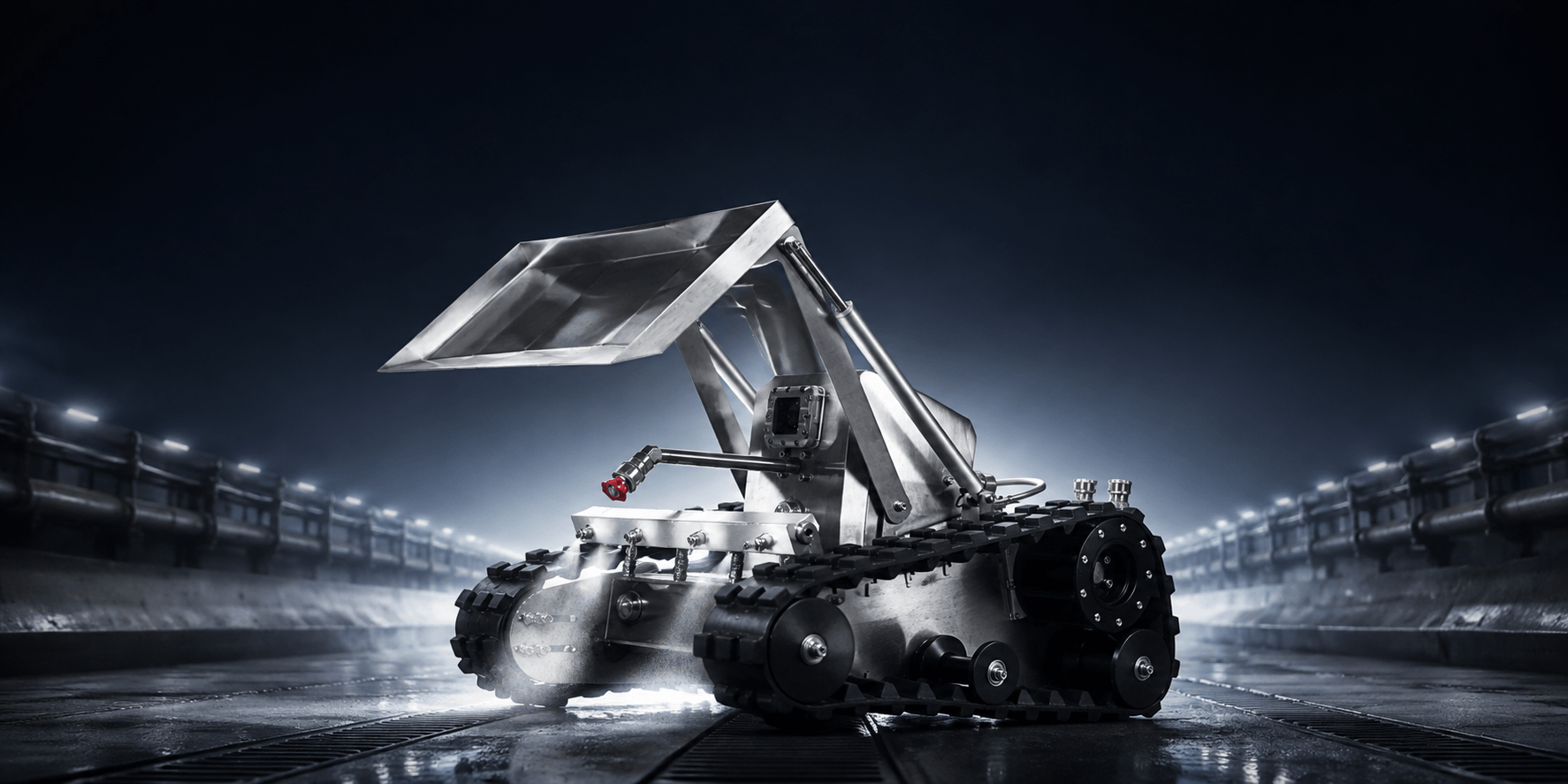
Once inside, tracked wheels and a climbing chassis let the S6 move across the floor, over settled sediment and up to 30° slopes. No scaffolding, no winches, no ropes — just remote control from outside the tank.
Cleaning Under 200 Bar of Pressure
The cleaning head is a rotating nozzle that spins a full 360° while a pump delivers water at up to 200 bar. That combination — rotation plus pressure — is what breaks residue off tank walls and floors that lances and brushes cannot shift.
The operator varies the pressure and travel speed for the residue type: light biofilm gets a gentle pass, compacted sludge gets the full 200 bar.
Watching Every Pass on Camera
Three HD colour cameras feed live video to the operator station. You see the nozzle, the surface being cleaned and the residue breaking away — in real time.
That visibility is what makes cleaning verifiable. When the surface looks clean on camera, the job is done, and the tank can be handed back with documented evidence.
A tank cleaning robot is a pump, a track and a camera on the end of a cable — but the result is a cleaning job done in hours, with nobody inside the tank.