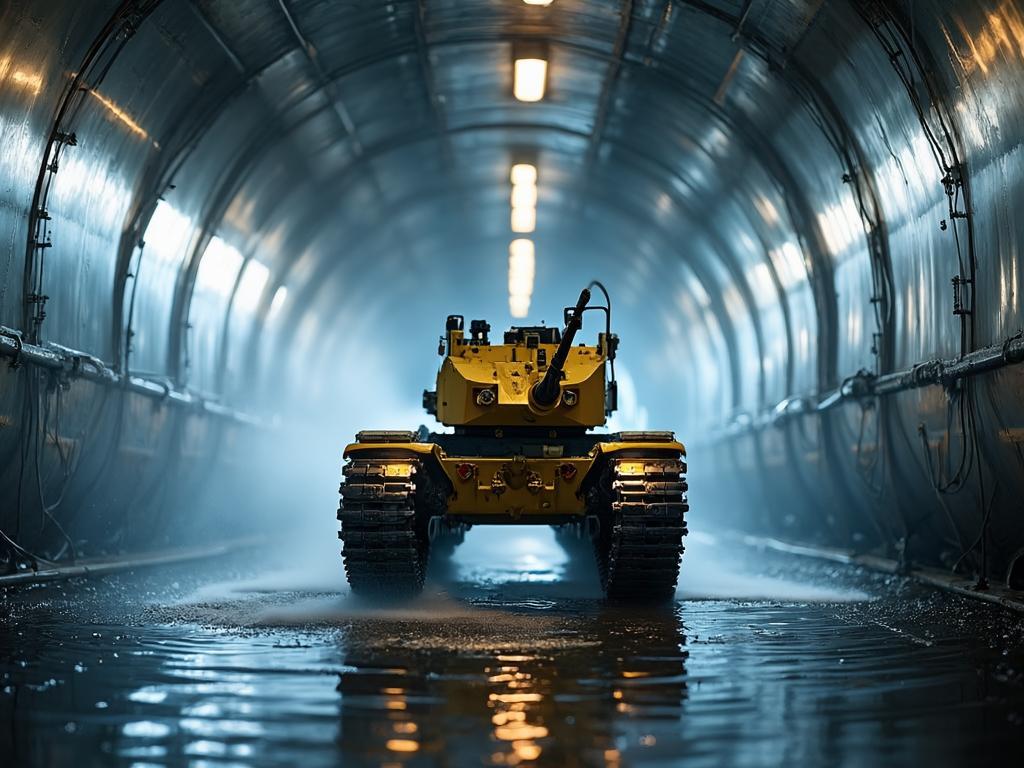
The question every tank operator asks before a product switch is simple: how does a tanker cleaning robot reach every surface inside a long, narrow cargo tank without sending a person in? For cargo tank cleaning, the short answer is tracked mobility, a rotating nozzle head and a camera feed from outside the vessel.
Why tank interiors are hard to cover
Road tankers, rail cars, intermodal containers and cargo tanks share the same obstacle pattern. They are built with baffles, stiffening rings, drain grooves and manways to keep the structure safe in transit. Those features create shadow zones for a fixed high-pressure lance. A stationary nozzle cleans only the surface directly ahead of it. The far end of a long, narrow shell can hold a layer of residue, which is the core problem in product-switch cleaning. Cleaning intermodal containers is no different: you need to move the nozzle to the surface, not rely on pressure alone.
How the RJ-BOT S6 navigates obstacles
The S6 uses a tracked chassis to climb a 30° slope and move over small structural steps inside the vessel. Its compact envelope of 430 × 380 × 530 mm and 24.5 kg weight makes it practical to move through access openings that match its size. The 60 m cable gives you reach from the entry point. Three HD cameras and 4 × 3W LEDs let the operator read a baffle edge or drain groove before steering into it.
Nozzle coverage comes from the 360° rotating nozzle with 45° up/down lifting. The jet can sweep the shell side, angle up to the roof area and then drop down toward the sump. At up to 200 bar and a 7 m jetting range, the water reaches surfaces that are not immediately beside the robot. This combination of mobility and nozzle rotation is what makes remote-controlled cleaning practical inside a cargo tank.
What to watch for on site
Use the S6 for tanks holding non-flammable / non-explosive materials only. If the tanker previously held a flammable or explosive product, that job requires a separate engineering and certification review. The S6 is not designed as an explosion-proof unit. The robot can reduce the need for confined-space entry in suitable applications, but permits, isolation, ventilation and gas testing remain the operator's process.
Product-switch regulations and cargo residue disposal are still your responsibility. Wash water recovery, static control and non-sparking tools are part of the surrounding wash bay procedure. The S6 does not integrate sludge suction. High-pressure jetting can loosen sludge and residue, but external suction or pumping follows engineering confirmation. After the run, use the camera feed for field inspection and build the cleaning report before approving the next load.
FAQ
How fast can a tanker be cleaned?
It depends on tank geometry, residue class, access and your verification standard. The S6's 7 m jetting range and 360° nozzle reduce repositioning time, but a realistic turnaround time is assessed after reviewing the tank. Pricing is subject to a site-specific quotation.
Can one robot handle different tanker sizes?
Many road tanker compartments fit the S6's 430 × 380 × 530 mm footprint and 60 m cable reach. For larger or unusually shaped tanks, the S7 custom-built variant can be configured around tank geometry, pressure and process.
Send your tank drawings, compartment layout and residue class to TankSolv's engineers. They can map a cleaning path for your fleet and prepare a site-specific quotation.